Search for the meaning of yellow roses and you will quickly run into contradictions: sometimes they are described as a symbol of friendship, sometimes of jealousy, sometimes of pure joy. No wonder so many people are unsure when – and to whom – it is appropriate to give them. This article clears up the confusion and explains what the symbolism really means, and how to make the most of yellow roses.
Today, yellow roses stand above all for friendship, warmth and sincere affection. They express goodwill and closeness without the romantic weight that red roses carry. If you want to tell someone "I value you" without raising romantic expectations, yellow roses are exactly right.
At the same time, they symbolise joy, optimism and new beginnings. In many European cultures, yellow roses are given at birthdays, anniversaries or as a pick-me-up – a colourful message that says: "I'm thinking of you and wish you all the best."
One outdated prejudice refuses to die: the idea that yellow roses signal jealousy or infidelity. This association comes from Victorian England in the 19th century, when the language of flowers – floriography – was interpreted very strictly. In Germany today, that negative connotation has almost entirely disappeared. Give yellow roses without hesitation.
Yellow roses originally come from the Middle East and Central Asia. The first known yellow wild rose, Rosa foetida, was brought to Europe from Persia in the 17th century. Its vivid colour fascinated gardeners and breeders immediately – it was something completely new to European eyes.
In the Victorian language of flowers, every colour was given a precise meaning. Yellow initially did stand for jealousy and mistrust – possibly because yellow had long been associated in Europe with envy and betrayal. Over the course of the 20th century, that image changed fundamentally: yellow became the colour of the sun, of spring and of positive energy. In Germany today, the positive interpretation clearly dominates.
Not all yellow roses are alike. The range runs from soft cream-gold to vivid sunshine yellow. Here are some of the most popular varieties you will find on the market:
If you do not want a single colour, yellow roses combine beautifully with other colours and flower types. Orange roses enhance the warm, energetic effect, while white roses add elegance and purity. Roses as a whole offer an enormous variety of varieties – from soft pastels to bold primary colours.
Yellow roses suit far more occasions than most people realise. Here is an overview of the most common ones:
For romantic declarations of love, red roses remain the more traditional choice. That said, yellow roses can absolutely be given within a relationship – as a sign of the deep friendship and connection that make a good partnership.
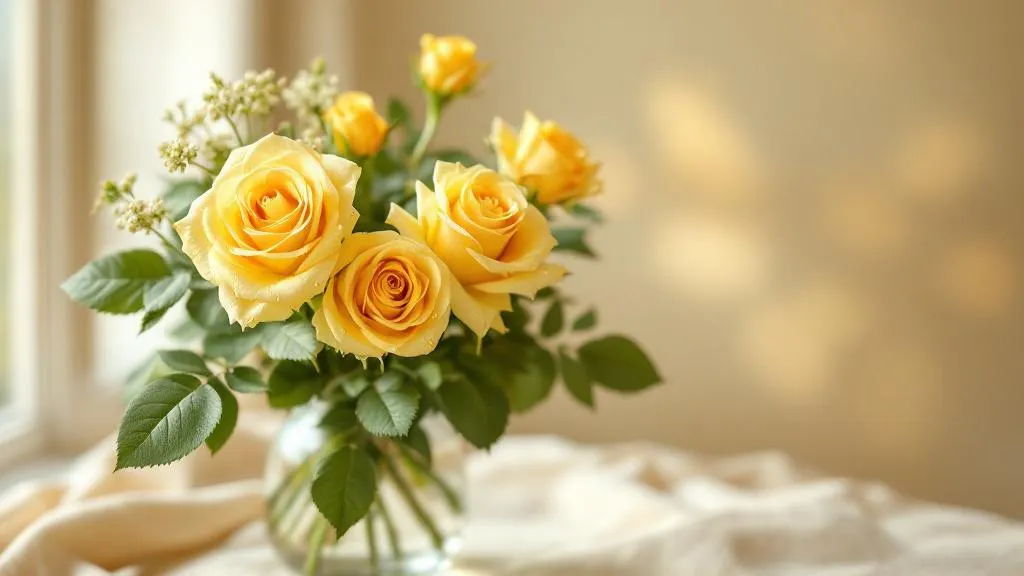
A monochrome bouquet of pure yellow roses looks modern and elegant. Combining them with other colours and flower types makes things even more interesting:
With the right care, fresh roses can easily last 10 to 14 days. Here are the key points:
When ordering yellow roses, freshness matters: roses shipped directly from the grower have a significantly longer vase life than flowers that have already spent several days in a wholesale warehouse or on a supermarket shelf.
The Netherlands is the world's largest exporter of cut flowers – more than 80 per cent of the roses sold in Germany come from there. Dutch growers have decades of experience cultivating cut-rose varieties and continuously refine vase life, bloom size and colour intensity.
At Regionsflorist.de, roses are packed immediately after harvest and dispatched within 24 to 48 hours. That means when you order yellow roses, they arrive with up to five extra days of vase life compared with flowers from a traditional shop – because there is no middleman. The bouquets are delivered as buds that open at the recipient's home, something no supermarket bouquet can offer.
All roses – yellow, red or pink – are available in a range of quantities: from 10 stems for a personal gift to 50 stems for events or weddings.
This meaning dates back to the Victorian 19th century and is largely outdated in Germany today. Modern associations are friendship, joy and warmth. Most people now connect yellow roses with positive feelings – not jealousy.
Yes – if you want to show your partner that you are not only in love but also bound by a genuine friendship. As a purely romantic declaration, red roses are traditionally the stronger gesture. But a mixed bouquet of red and yellow roses can send a very personal message.
In Germany it is customary to give an odd number – 5, 7, 11 or 21 roses are classic quantities. Even numbers are traditionally associated with mourning, although this rule is rarely observed strictly in everyday life. For a generous bouquet, 15 to 20 stems is a lovely choice.
With proper care – fresh water, a cool spot and a diagonal cut – fresh roses sent directly from the grower typically last 10 to 14 days. Supermarket roses often last only 5 to 7 days, because they have already spent several days in transit before reaching the shelf.